
Minerva Mill Atlas Mill Ryecroft Mills | Fern Mill Wellington Mill | Buckton Vale Printworks
This former cotton spinning mill was located at the bottom of Minerva Rd in the Whitelands District of Ashton, and it was in a 90° bend in the river Tame. Its neighbour to the east was Texas Mill at the bottom of Texas St. The mill was built of engineering red brick in 1891/92 for the Minerva Spinning Co Ltd and this company was the founder member of the Ashton Syndicate. This syndicate was a consortium of investors responsible for financing the construction of seven large cotton spinning mills in Ashton-under-Lyne during the early 20th century. The primary members of the syndicate, all directors of the Minerva Spinning Co Ltd, were: Edwin Barlow, George Henry (Harry) Coop (1866-1922), Lees Hyde Marland (1863-1925), Samuel Newton, John William Pollitt (1867-1930), and Joseph Boothby Pownall (1864-1911). In 1921 the Ashton Syndicate was re-floated as the Atlas Mills Group (Atlas Mills Ltd). The seven mills in Ashton were: Atlas, Cedar, Curzon (aka Alger), Minerva, Rock, Texas, and Tudor.
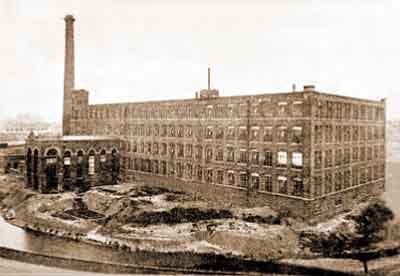
The architect for the design of this mill was the renowned Sir Philip Sidney Stott, 1st Baronet (1858-1937) of Oldham and the contractors were E J Smethurst of Oldham. The steam engine was a triple expansion engine built by Daniel Adamson & Co Ltd of Newton Moor Iron Works, Adamson St, off Dewsnap Ln, Dukinfield. The mule frames were provided by John Hetherington & Sons Ltd of Vulcan Works, Pollard St, Ancoats, Manchester. At startup there were 80,868 spindles rising to 93,828 spindles by 1903.
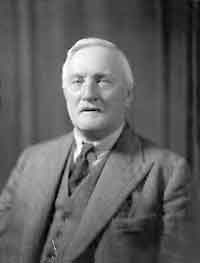
The mill ceased cotton spinning in the 1920s, during the decline of the Lancashire cotton industry, and it was demolished in 1937.
This former cotton-spinning mill was located on Atlas St in the Waterloo District of Ashton, off the east side of Oldham Rd and it was about 200 yards to the south east of Rock Mill. The mill was built of engineering red brick in 1898/1900 by the Ashton Syndicate (the Minerva Spinning Co Ltd was the founding member). The architect for the design of this mill was Sir Philip Sidney Stott and the contractors were J Partington & Sons of Middleton Junction, Middleton/Chadderton.
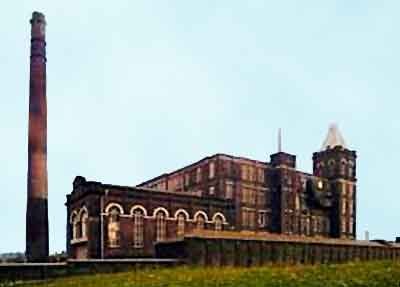
The mill was built of red engineering brick. It was 4-storeys, with a basement, and it had yellow-brick decoration. The large windows along its length were in groups of three. A notable feature was the ‘Hotel-de-Ville’ style water tower. The 6-bay engine house, boiler house and chimney were to the north. The chimney featured Stott’s trademark, two rings near the top. The steam engine was built by George Saxon & Co Ltd of Openshaw, Manchester, and the mill operated around 72,928 spindles using mule frames.
In 1921 the mill became part of the Atlas Mills Group (Atlas Mills Ltd), a re-float of the Ashton Syndicate where it was used as the headquarters of Group. In 1929 it became part of the Lancashire Mills Corporation (LCC). In 1964 it was absorbed into Courtaulds Northern Textiles Division following its acquisition of LCC. In 1987 Atlas Mill switched to spinning artificial fibres, such as rayon, but in Sep 1990 production ceased and the mill was closed by Courtaulds. It was the last mill in Ashton to cease spinning. In 1994 the mill was demolished and the site was developed for housing.
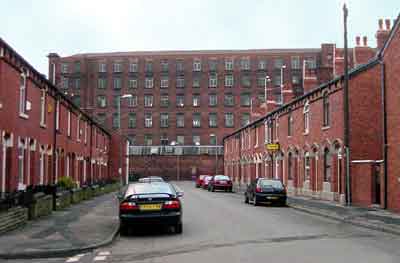
Ryecroft Mills are located on Smith St on the corner of Ryecroft St. The family business was founded by Abel Buckley Sr (13 Apr 1794-14 Apr 1865) and his brother, John Buckley (1798-1860), and it is understood that a mill was established on the site as early as 1824/25. It was to become a cornerstone of the economy in the Ryecroft area of Ashton-under-Lyne. The mill on Smith St opened in 1834 with additions in 1837 and later in the 19th century. The family also owned Oxford Street Mill (not to be confused with the nearby Oxford Mills). Abel Buckley Sr became the first Mayor of Ashton-under-Lyne 1847/48 and 1848/49.
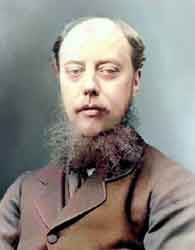
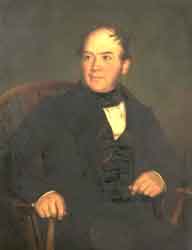
The 3-storey range fronting Smith St is 10-bays wide by 4-bays long and the large range behind is 5-storeys, with a basement, and 26 bays long on Ryecroft St.
By 1891 Ryecroft Mills had 59,000 spindles and 357 looms, demonstrating that they were fully integrated for both cotton spinning and weaving. The mills were in textile production until the 1970s.
In 1844 the London Gazette recorded that by 1831 the family business was styled Abel Buckley & Co and that the partners were Abel Buckley Sr (1794-1865), John Buckley (1798-1860), Nathaniel Buckley (1820-1892), and James Smith Buckley (1805-1851). The London Gazette for 1894 recorded that by this time the family business had been incorporated as Ryecroft Mills Co Ltd and the water tower of the mill on Smith St displays this company name in white-glazed bricks.
The family business was eventually inherited by Abel Buckley Jr (1835-23 Dec 1908) who was a JP and briefly the Liberal MP for Prestwich (24 Nov 1885-1 Jul 1886). He was also the Mayor of Ashton-under-Lyne (1873/75). In 1885 he moved into Ryecroft Hall in Audenshaw where he lived for the rest of his life.
In 1895 the Ryecroft Mills Co Ltd erected the 3-storey Fern Mill, at the bottom of the nearby Charges St, as an extension of Ryecroft Mills. This was demolished in 2007/12.
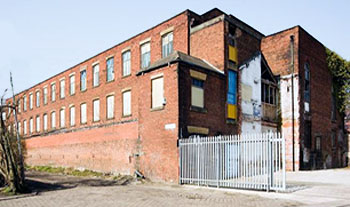
This mill is situated on the south side of Whitelands Rd between the road and the Huddersfield Narrow Canal.
It dates from 1857 and by 1891 it was owned by John H Gartside & Co Ltd. It had 76,128 spindles, producing 328 twist, 308/608 weft, and 2,004 looms.
About 485 yards to the east of Wellington Mill is the surviving Whitelands
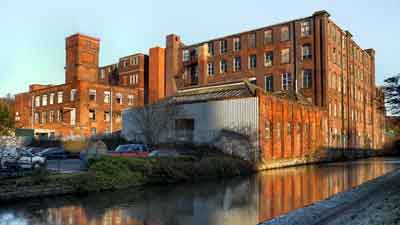
John H Gartside & Co Ltd was a company of cotton spinners and weavers who also undertook calico printing, bleaching, dyeing and finishing. Additionally, they specialised in the manufacture and finishing of bookbinders’ cloth. This cloth is a specially prepared fabric used to cover hardback books, journals, and boxes, etc. It provides structural strength, protects books from wear, and gives them a premium appearance. Unlike standard textiles, bookbinders' cloth is specially treated to withstand the book-binding process.
As well as Wellington Mill, John H Gartside & Co Ltd owned Buckton Vale Printworks off the east side of Castle Ln, Carrbrook, Stalybridge. This works was primarily a bleaching and calico printing mill.
The company also owned Bridge Eye and Chapel Hill Mills in Dukinfield, Albion Mill and Arrowscroft Mill in Hollingworth, and Pin Mill (905 looms) in Ardwick, Manchester.
They had offices and a warehouse on Fountain St, Manchester, and offices in Blue Boar Court, Friday St, City of London.
