
Tudor Mill Cavendish Mill Junction Mills Walk Mill Oxford Mills Waterside Mill
This former cotton-spinning mill (with ring-spinning frames) was located at the bottom of Portland Street South beside the Ashton Canal, which was used to supply raw cotton and coal for the boilers. It was bordered to the east by Higher Bank Mill (set back from the Ashton Canal) and Cavendish Mill, and to the west by Ashton New Warehouse (set back from the canal), and Junction Mills.
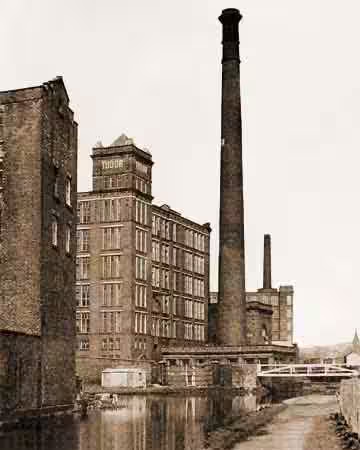
The mill was built in 1901/03 for the Tudor Mill Company Ltd by the Ashton Syndicate (the Minerva Spinning Co Ltd was the founding member) and the architect for its design was the renowned Sir Philip Sidney Stott of Oldham. It was six-storeys high, with a basement, and about 57-yards wide by about 90-yards long with a corner water tower. The water tower was an architectural feature in Stott’s mill designs used to give aesthetic appeal in addition to its practical use. The engine and boiler house were detached and the boiler-house chimney featured Stott’s trademark, two rings near the top. The steam engine was a 1,800 IHP vertical triple-expansion engine built by George Saxon & Co Ltd of Openshaw, Manchester.
When Tudor Mill opened in 1903, it employed around 250 workers and operated 85,464 spindles. The cotton industry went into depression in the 1920s and the mill became part of the Atlas Mills Group* (Atlas Mills Ltd*). In the early 1930s it was sold to the Lancashire Cotton Corporation (LCC) and in 1964 LCC it was acquired by Courtaulds Northern Textiles Division. In 1968 the mill ceased spinning and in 1969 it was briefly occupied by Latafoam Ltd. Afterwards it was used as a warehouse. On the 24 Jun 1970 the mill was destroyed by a major fire and the site is now occupied by apartments.
This former cotton-spinning mill is located on Cavendish St beside the Ashton Canal with Bank St on the opposite side to the canal. It was built in 1884/85 for the Cavendish Spinning Co Ltd and the architects for its design were Potts, Pickup, and Dixon of Oldham and the contractors were Storrs, Sons & Co Ltd of Stalybridge. The mill is 6-storeys high facing the canal and 5-storeys high on Bank St, with a flat roof. It is especially is notable for its innovative industrial design and distinctive octagonal staircase that wraps around the chimney stack. Curiously, the chimney has two rings near the top, which was the trademark of the renowned architect Sir Philip Sidney Stott of Oldham. It was the first mill in Ashton to use concrete floors resting on steel girders instead of traditional brick arches supported by cast-iron columns, a major innovation at the time.
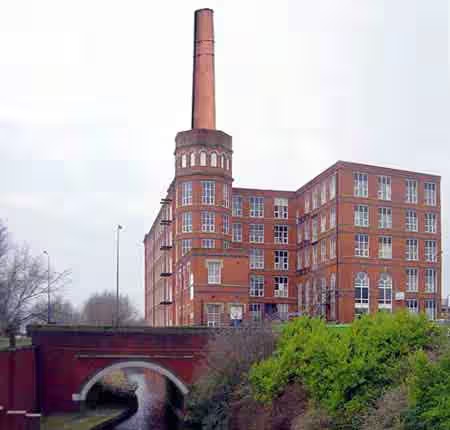
The London Gazette records that in Feb 1920 the Cavendish Spinning Co Ltd held an Extraordinary General Meeting at Minerva Mill, Minerva Rd, Ashton-under-Lyne, to pass a resolution to voluntarily wind up the company. Evidently this did not happen and Cavendish Mill continued to spin cotton until 1934. Afterwards, the mill was occupied by Bentinck Street Silk Works Ltd who used it to process rayon. This company went into liquidation in 1976 following which the building was used for a variety of purposes until it was converted into apartments in 1994.
Cavendish Mill is listed Grade II*, List Entry No. 1067948.
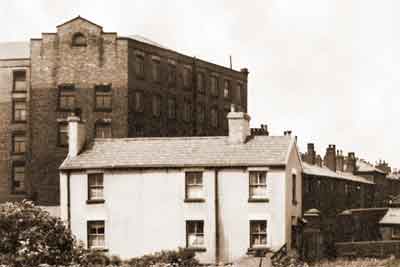
Junction Mills was a large complex of cotton-spinning mills and weaving sheds located to the west of the Portland Basin, between Welbeck St and Margaret St with another range to the west of Margaret St. They were founded in 1831 by Samuel Heginbottom and expanded between 1831 and 1890. His sons, William and George, were business partners and The London Gazette records in 1850 that the business was styled Samuel Heginbottom & Sons and that at this time Samuel stepped down to leave his sons to continue the business. It was incorporated in c.1896/97 as Heginbottom & Sons Ltd.
By 1833, he had built a 5-storey cotton-spinning mill at a cost of about £5,000. He built another 5-storey mill by 1835 and it is recorded that this was used to hold a banquet before the machinery was installed and as a result this became known as the ‘Banquet Mill’. By 1891, the firm was operating 48,000 spindles and 1,126 looms, producing various fabrics including velvet and Jacquard fabrics. The latter were woven by the Jacquard loom, patented by Joseph-Marie Jacquard in 1804, which is a mechanical loom that revolutionised textile manufacturing by using punched cards to automate the weaving of complex patterns.
Samuel Heginbottom (12 Oct 1786-3 Aug 1860) married Ann Griffith (1787/88-1851) at St Mary’s Church (Church of St Mary with St Peter), Church Terrace, Oldham, on the 28 Apr 1806. Samuel and Ann are both buried in the churchyard of St Peter’s Church on Manchester Rd, Ashton-under-Lyne. Their son, William, was born on 29 Mar 1807 at Ashton-under-Lyne and died on the 1 Mar 1865 at Ashton-under-Lyne. Their son, George, was born 6 Mar 1810 at Ashton-under-Lyne and died on the 5 Mar 1877 at Southport.
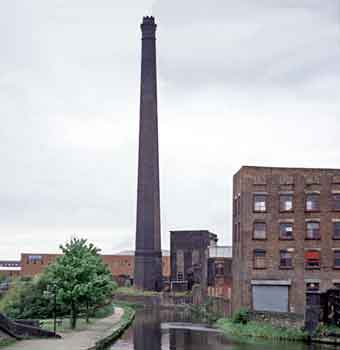
The firm went out of business in 1930 but it was not until 1943 that it was struck off the Register of Companies. From 1930 onwards the mill complex was gradually demolished and in 1987 the final standing parts of the original 1831 mill buildings were demolished. In 2000 the site was fully cleared for redevelopment with the exception of the iconic boiler-house chimney. This 210-foot tall octagonal chimney, built in 1867, features a distinctive tulip-shaped top and it was built to improve the efficiency of the boilers. It was restored by Tameside Council in 2000 and is preserved as a local industrial landmark.
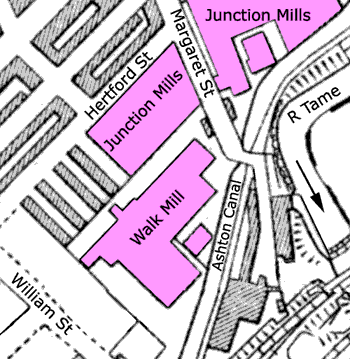
Walk Mill was located at the bottom of Margaret St on the west side and it was bordered on the north side by a range of Junction Mills and on the south side by the Ashton Canal, adjacent to Walk Bridge (53.48107, -2.10223).
It got its name from the nickname for fulling mills. In fulling mills, large wooden hammers beat woven woollen cloth to cleanse it and thicken the fibres. Because the mechanical rhythmic stamping of the hammers resembled human walking, they were universally called ‘walk mills’.
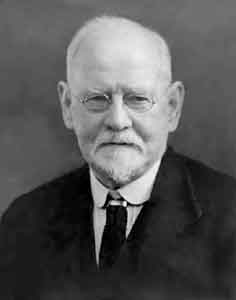
The date of construction of Walk Mill is uncertain but early ownership was by the Lees brothers, John and Joseph, who were the sons of the cotton master, Robert Lees, who founded the nearby Bridge Eye Mill in 1815. Later, it was worked by the brothers, John Hamer JP (1842-1912) and William Hamer JP (1844-1935), who were born in Crompton which is about 3½ miles north of Oldham town centre.
The brothers also worked Union Mills (53.47603, -2.11678) which were located about 0.7 miles away on the east side of York St, Audenshaw, near Guide Bridge.
The Ashton Canal Distance Table for 1888 records that the Hamer brothers were working Walk Mill and Union Mills by this year. On the 17 Jun 1915 a devastating fire broke out at Union Mills and they were not repaired and put back into use.
The Freedom of Ashton-under-Lyne was conferred on William Hamer JP on the 18 Feb 1931 for his services to the Borough as a Liberal councillor, alderman and mayor (1902/03).
The combined mills had 92,500 spindles using mule frames and the twist was 248/428.
The historic notation 248/428 refers to the Yarn Count range that the Walk Mill could produce. The notation is first re-written as 24/8 and 42/8.
The lower Count Size number (24) represents a thicker heavier yarn, while the higher Count Size number (42) represents a finer, thinner yarn.
These two fractions then translate as follows, where 's' stands for 'singles':
24/8 equates to 8 strands of Yarn Count Size 24s cotton plied together. 42/8 equates to 8 strands of Yarn Count Size 42s cotton plied together. The second fraction indicates a significantly thinner yarn than the 24/8, because while they have the same number of plies, the individual strands in the 42/8 are much finer.
However, later in the 19th century, the top floor of Walk Mill was equipped with newly designed ring-spinning frames built by the textile machinery manufacturer, Platt Brothers & Co Ltd of Oldham, in order to maximise yarn output.
Oxford Mills was an integrated complex of cotton-spinning mills and a weaving shed located on the south side of Oxford Street East and bounded to the south by the Ashton Canal for the supply of raw cotton and coal for the boilers. Thomas Mason (1781/82-1868) was the founder of Oxford Mills and his son, Hugh Mason (1817–1886) eventually took full control of the business by 1859/60.
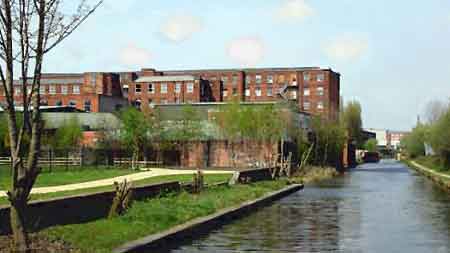
Initially, the company was styled Thomas Mason & Sons, the partners being Thomas and his three sons, Henry, Booth, and Hugh. Henry retired in 1848 and Booth retired in 1853. The company was then restyled as Thomas Mason & Son. Thomas Mason retired in 1859/60.
Following the death of Hugh Mason in 1886 his son, Rupert Mason, and business partner Francis Howarth (Frank) Bazley (1876-1942) took control until Rupert died in 1931. This left Frank Bazley in full control as the managing director. The company was incorporated in 1927 [Thomas Mason & Son (Ashton-under-Lyne) Ltd] and continued trading until Mar 1956.
The complex was comprised of two spinning mills on either side of a warehouse and office block. There was also a carding room and a weaving shed. The carding room is where tangled raw cotton is cleaned and transformed into continuous ‘slivers’, which are untwisted ropes of cotton fibres. The sliver is an intermediate product that serves as the bridge between raw cotton and spun yarn and they are made with carding machines. Slivers are then transformed into thinner, slightly twisted, strands called ‘rovings’. This is the final step before the cotton is spun into yarn and this product is made with roving machines.
The two mills are dated 1840 and 1851 and the warehouse to c.1850. The weaving shed is understood to have been a later addition. Mill No. 1 was 6-storeys, 6-bays wide by 28-bays long and Mill No. 2 was of similar construction but smaller. The two mills were connected by a bridge on the second floor. The warehouse was 5-storeys, 5-bays wide by 10-bays long and the office was 2-storeys. The addition of a weaving shed made the complex a fully integrated cotton mill.
The 8-bay weaving shed had a roof with a north-light or sawtooth design. The steeper side of each tooth faced north and was glazed while the shallow side was covered with an opaque material to shield the interior from the sun. This ensured consistent good-quality light needed inside for the weavers operating the looms.
Oxford Mills were listed Grade II, List Entry No. 1084307, but they were destroyed by fire on the 6 Aug 2019.
This mill was located in the Whitelands District of Ashton-under-Lyne on the north side of Lower Alma St (53.48274, -2.09644). Furthermore, it was bordered by the river Tame on the north side and it was adjacent to Garforth’s Private Branch (aka Alma Street Private Branch) of the Lower Peak Forest Canal on the south side.
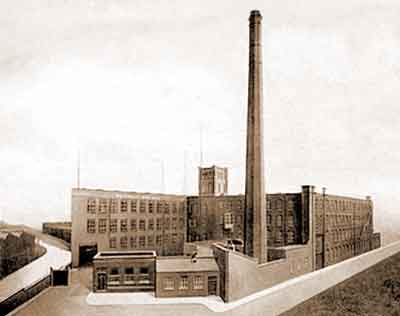
The mill was built in two stages. The original, in 1857, was the building of a weaving shed and the second, in 1863, was the building of a separate 4-storey spinning mill adjacent to the weaving shed. It is understood that at this time the two firms were operating independently of each other.
By 1891 the two firms had merged and the Waterside Mill Co Ltd had been incorporated. At this time there were 34,602 spindles spinning 328 twist, which is a soft yarn. By 1880 the main mill was powered by a 640 IHP horizontal compound steam engine and by c.1911 it had been completely converted to electricity to optimise efficiency. In 1896 the mill name was changed to Alma Mill when it was leased by Leech, Hardy & Co. The proprietor was Edward Leech, trading as a merchant reeler and this business closed in c.1914.
During the interwar years there was severe over capacity in the cotton industry with plunging prices caused by the Great Depression. Consequently, in the 1930s Waterside Mill was acquired by the Lancashire Cotton Corporation Ltd (LCC). The LCC was a company set up by the Bank of England in 1929 to rescue the Lancashire cotton industry. Around this time the mill was producing ring twist yarn in Cotton Counts 26s to 40s using Egyptian and American raw cotton.
The era after the end of World War II brought about intense global competition in the cotton industry. In 1959 production at Waterside Mill permanently ceased and it was closed by the LCC, marking the end of its 102-year contribution to Tameside's textile heritage.
