
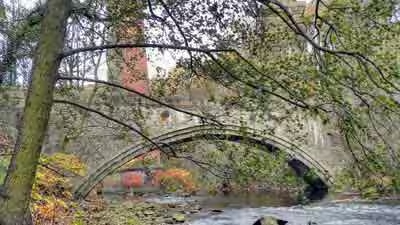
Broadbottom Bridge over the river Etherow viewed looking upstream (northwards). Note the compound arch with three recessed rings.
The two piers in the background (one red brick and one stone) belong to Broadbottom Viaduct (or Etherow Viaduct) built in 1842 for the Sheffield, Ashton-under-Lyne and Manchester Railway, later the Manchester, Sheffield and Lincolnshire Railway, and then the Great Central Railway. Originally there were three spans supported by stone piers but in 1919 three red-brick intermediate piers were built.
The village of Broadbottom lies about one mile to the south of Mottram in Longdendale. The first bridge on this site in the Longdendale Valley is said to date from 1683 (Sir Nikolaus B L Pevsner) and over the years there may have been several re-builds. An engraving of 1794 shows that the bridge was then a hump-backed bridge. At this point the river Etherow is about 63 feet wide and the present bridge has one large compound arch span with concave retaining walls on both sides. It is stone built with uneven squared rubble and dressed stone parapet walls with chamfered coping stones. A notable feature of the bridge is the compound arch with three recessed rings or orders.
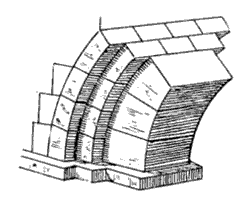
Section of a compound arch with three recessed rings.
The alternative name of the bridge (Besthill Bridge) refers to Besthill Mill, a cotton mill established about 225 yards upstream of the bridge in 1784.
The bridge is listed Grade II, List Entry No. 1087983.