
Holy Trinity & Christ Church | Victoria Market Hall Astley Cheetham Library & Art Gallery | Post Office War Memorial | Statue of Jack Judge | Stalybridge Town Hall Melbourne Court | Victoria Bridge
Trinity Street is in Tameside's Stalybridge Town Centre Conservation Area.
Holy Trinity & Christ Church
 This church stands on the east side of Trinity St and
it is adjacent to the former Victoria Market Hall on the opposite side of Corporation St.
The foundation stone was laid on Easter Day 1851 and it was completed in 1852. The bells were installed in 1853. It was built in the Perpendicular style and the architect was Edwin Hugh Shellard (1815-1885) of Manchester.
It was built of snecked stone with a slate roof. Improvements to the church were made in 1931 and the architect was Percy Howard of Manchester.
This church stands on the east side of Trinity St and
it is adjacent to the former Victoria Market Hall on the opposite side of Corporation St.
The foundation stone was laid on Easter Day 1851 and it was completed in 1852. The bells were installed in 1853. It was built in the Perpendicular style and the architect was Edwin Hugh Shellard (1815-1885) of Manchester.
It was built of snecked stone with a slate roof. Improvements to the church were made in 1931 and the architect was Percy Howard of Manchester.
Holy Trinity & Christ Church is listed Grade II, List Entry No 1068022.
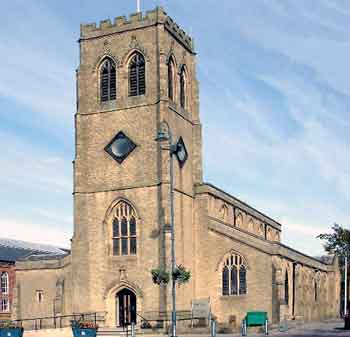
Holy Trinity & Christ Church.
Holy Trinity & Christ Church obtained this combined name in 1977 as a result of the merger of the Parishes of Holy Trinity and Christ Church. This was largely due to the redevelopment of the Castle Hall district of Stalybridge. This district takes its name from a hall that once stood near Victoria Market Hall on Trinity St, close to the river Tame, that was demolished in 1861.
Christ Church
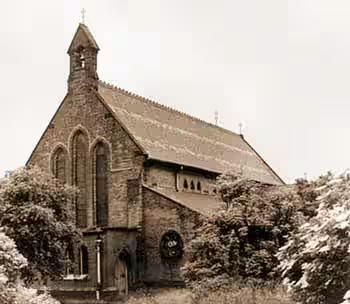
This church was erected in 1877-79 on the east side of Quarry Street, about 82 yards from its junction with High St.
The architects were John Eaton & Sons of Ashton-under-Lyne, and it was built of stone with a fish-scale banded slate roof.
The church closed in 1976 and was demolished sometime afterwards due to structural issues.
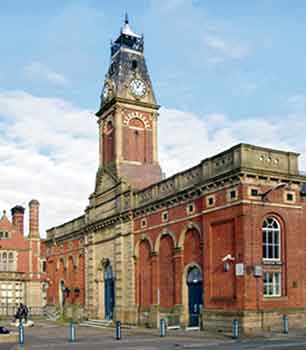
Victoria Market Hall, now Stalybridge Civic Hall [1].
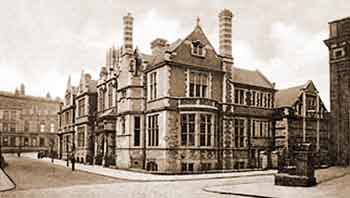
Astley Cheetham Public Library and Art Gallery & Post Office, early 20th century [2].
In this view the Post Office is at the far end of the building.
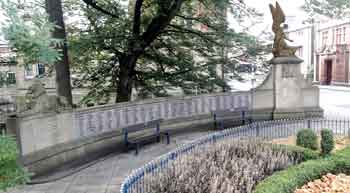
The segment of the war memorial on the east side of Trinity St showing the winged angelic figure supporting a dying sailor to the right and a lion couchant to the left [3].
The river Tame flows between the War Memorial and the Post Office.
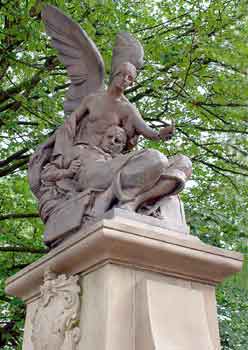
The winged anglic figure on the east side of Trinity St supporting a dying sailor.
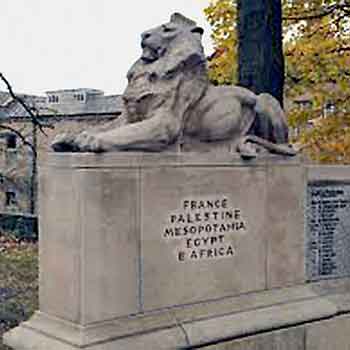
The lion couchant on the east side of Trinity St.
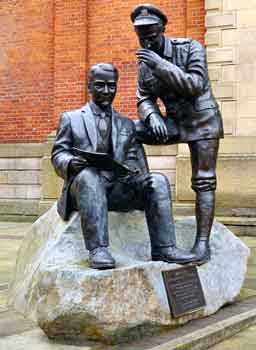
Statue of Jack Judge and a Great War soldier outside Victoria Market Hall, now Stalybridge Civic Hall [4].
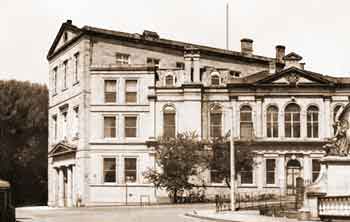
Stalybridge Town Hall viewed from Trinity St, 1950s [5].
The Waterloo Rd/Trinity St portico of the Town Hall is to the left and the winged angelic figure of the War Memorial on the east side of Trinity St is to the right.
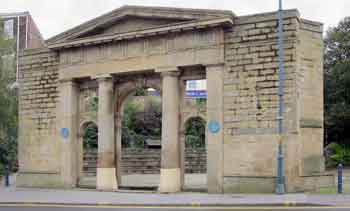
The Waterloo Rd/Trinity St portico of the former Stalybridge Town Hall².
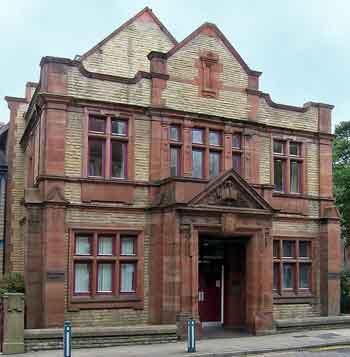
Melbourne Court, formerly a Sunday School, on the east side of Trinity St [6].
Victoria Bridge is off the picture to the right.
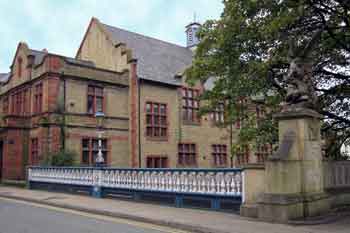
Victoria Bridge over the river Tame with Melbourne Court in the background [7].
Victoria Market Hall, now Stalybridge Civic Hall
This indoor market hall was built in 1866/68 by Amos Lee¹. It is 9 bays wide by 13 bays long and it is brick built on ashlar stone foundations with a clock tower above the stone-faced main entrance on Trinity St.
The interior retains its stone-flagged floor and locally made cast-iron columns support three parallel-pitched roofs. There are remnants of small interior shop units around the perimeter.
During 2024/25 the hall was refurbished and then reopened as the Stalybridge Civic Hall.
Victoria Market Hall is listed Grade II, List Entry No 1068023.
Astley Cheetham Public Library and Art Gallery & Post Office
Built 9 Oct 1897-16 Oct 1901, the architect for the library and art gallery was James Medland Taylor (1834-1909) of Manchester and the contractor was Isaac Gould of Leeds. The Post Office was designed by H M Office of Works.
The Astley Cheetham Library and Art Gallery was a gift to the town by John Frederick Cheetham, a local mill owner, philanthropist, and Liberal MP for Stalybridge, and his wife, Beatrice Astley.
The building is two-storeys high and six-bays wide. The matching post-office building to the left is two-storeys high and three-bays wide. Both buildings are in the Jacobean Revival style with dressed stone to the ground floor, brick to the first floor and clay-tile roofs.
The Library and Art Gallery is listed Grade II, List Entry No. 1356492.
War Memorial
The sculptor was Ferdinand Victor Blundstone (1882–1951) who was born in Switzerland and first studied art at Ashton-under-Lyne.
The memorial is in two segments on either side of Trinity St. The curved walls terminate with a winged angelic figure at one end and a lion couchant at the other end.
To the east the winged angelic figure is supporting a dying sailor and to the west a dying soldier.
The War Memorial is listed Grade II*, List Entry No. 1163074.
Statue of Jack Judge
This statue of Jack Judge (born John Judge, 1872-1938) was unveiled on the 16 Dec 2005. It is situated below the clock tower of Victoria Market Hall, close to the site of the Grand Theatre on Corporation St.
It was sculptured by John Cox and made at the foundry of Escar UK Bronze. It shows Jack seated on a granite rock with a Great War soldier looking over his shoulder.
He was inspired to compose the famous marching song, ‘It’s a long way to Tipperary’. Jack is holding a sheet of music while the soldier is playing his mouth organ.
During the evening of the 31 Jan 1912, Jack performed the song, with his brother Ted, at the Grand Theatre for the very first time. Later, the theatre was converted into a cinema and re-named the Hippodrome Theatre and then it became a bingo club. By 1964 only the façade remained and this is still extant but much altered.
Former Stalybridge Town Hall
The town hall opened on the 30 Dec 1831 to serve a rapidly growing and industrialising town.
It was designed in a neoclassical style (a revival of ancient Greek and Roman architectural styles) and initially it housed a market hall on the ground floor.
A large Italianate extension was opened in Sep 1883 to reflect the growing prosperity of Stalybridge. This included a council chamber, mayor’s parlour, and a public hall, all complete with ornate plasterwork.
During the 19th century the town hall became a centre for meetings of historic labour movements. It hosted meetings during the First General Strike (aka the Plug Riots) of 1842 and the Cotton Famine of 1862.
Following the formation of Tameside Metropolitan Borough Council in 1974 the town hall became redundant as it lost its status as a seat of local government. Consequently, the vacant building fell into disrepair and demolition was being considered. Ultimately, it was decided to demolish the building and work had started when a major fire destroyed what was left of the building in June 1989 with the exception of the Waterloo Rd/Trinity St portico. The portico was saved and site was subsequently landscaped and turned into a garden. The portico is listed Grade II, List Entry No. 1067987.
Melbourne Court, formerly a Sunday School
This building was erected on Trinity St, beside the river Tame, in 1904-05 as an addition to a Congregational Church built in 1859-62.
The foundation stone was laid by John Frederick Cheetham who gave £1,000 towards the cost of the building, which faces the library and art gallery that he and his wife, Beatrice Astley, had financed a few years previously.
The Sunday School worked with the Mechanics’ Institute on High Street to run adult education classes, including addresses by notable figures.
Melbourne Court is listed Grade II, List Entry No. 1261179.
Victoria Bridge
This bridge was built in 1867 to take Trinity St over the river Tame and it was manufactured by Henry Bayley, Son & Co of the Albion Iron Works, Hulme Hall Ln, Miles Platting, Manchester.
It consists of two wrought-iron girder spans with cast-iron parapet walls in the form of balusters with centrally placed street lamp standards bearing the Stalybridge Coat of Arms and the bridge name.
The base of the parapet walls are cast with the words, ‘Henry Bayley Son and Co. Albion Iron Works Miles Platting’ and the lamp standards have a plaque with the date ‘1991’ to record when the bridge was restored.
Victoria Bridge is listed Grade II, List Entry No. 1356470.
